
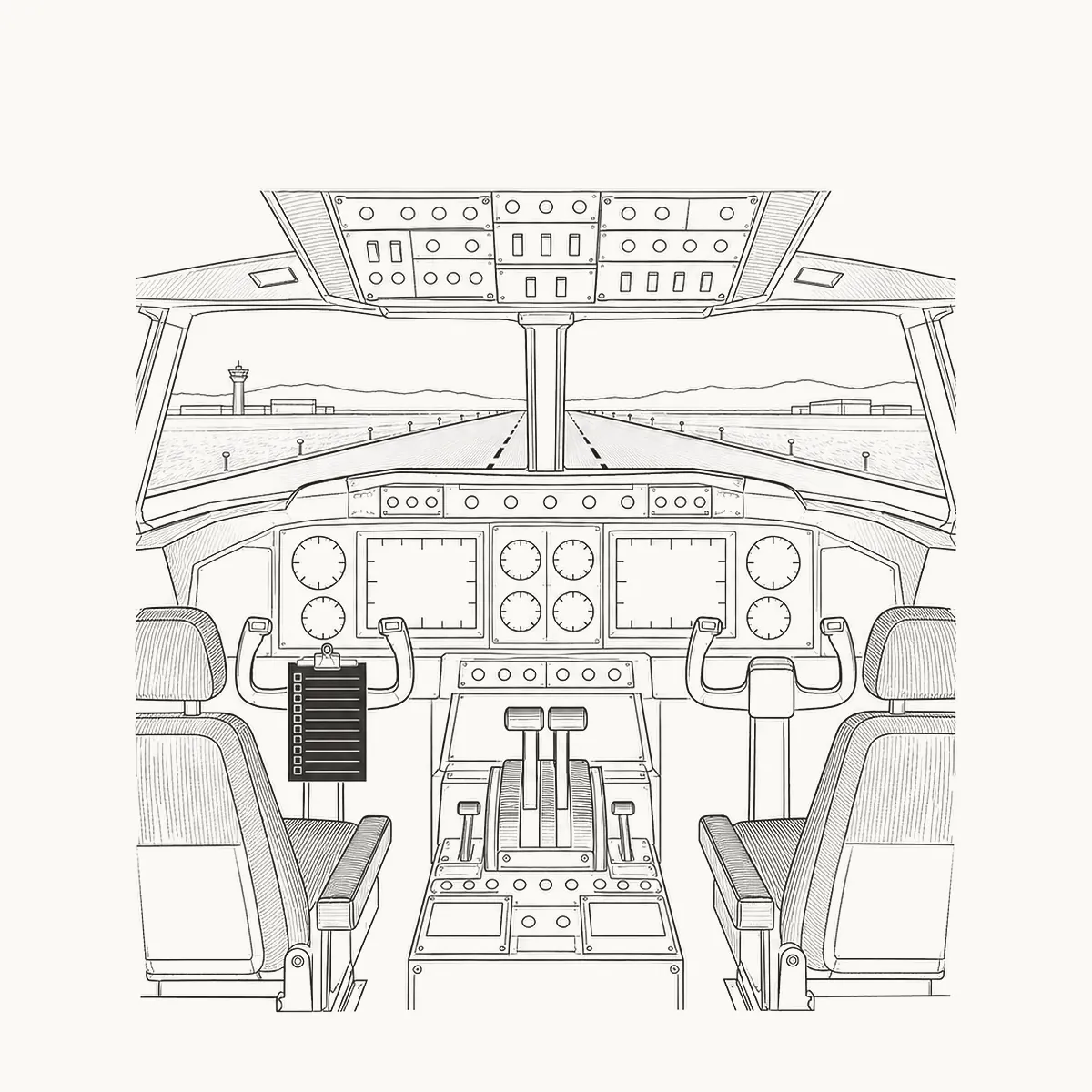
Next time you fly, watch the crew before takeoff. A pilot walks around the airplane and looks it over, even though it landed an hour ago and was fine then. In the cockpit, two people read a checklist aloud to each other, though either could recite it from memory. The flight attendants check the doors and say so out loud.

None of that is doubt. It is what an industry does once it has learned where trouble comes from. Trouble rarely comes from the ordinary flight. It comes from the day someone skipped a step because they were running late, or because it had always been fine before.
I think about that often, because it is the most accurate picture I know of how we run this company. But the picture has a part that passengers never see, and it is the part I care about most.
Someone wrote that checklist
The captain did not write the checklist. Long before an airliner carries its first passenger, test pilots take it up and go looking for trouble on purpose. They shut down an engine in the middle of a takeoff. They slow the airplane until the wing stops flying. They bring it to a stop from full speed on brakes that have been worn down to their limit. They do all of it with no passengers aboard and engineers watching every number, so that the answers exist before anyone needs them.
That is the test pilot’s job. It is not to react well when something goes wrong. It is to go and find out what can go wrong, ahead of time, and to write down what the crew should do about it. The checklist read aloud on your flight is the record of every question those people thought to ask.
Some lines on it were learned the hard way, from flights that ended badly. Many more were not. They are there because someone looked ahead and asked a plain question: what could happen here, and what do we want to be true when it does?
I bring this up because we are not only the crew that flies your property every day. We are also the people who wrote the checklist.
We were the test pilots
I was an owner before I was a manager. When we started this company, nobody handed us a manual, and I did not want to learn the business one failure at a time. So we walked through the life of a rental, from the first phone call to the day the last key comes back, and at every step we asked what could go wrong. Then we decided, in advance, what we would do about it.
You can see the answers all through the way we work.
- A new tenancy is inspected early. We would rather know in the first weeks how it is going than find out a year later.
- The amount we can spend on a repair without calling you is agreed for each property before we manage it. Nobody should be deciding who decides while a water heater is leaking.
- Our after-hours emergency line was built in-house, around our own properties. An emergency alert is not finished when a phone rings. It is finished when a person accepts responsibility for it. We made that decision at a desk, in daylight, not at two in the morning.
- Our screening criteria are written down before an application arrives, so every applicant is measured against the same thing.
- A home is cleaned and repaired before it is photographed, not after someone asks to see it.

I will not pretend all of it came from foresight. Some of what we do, we learned from experience, the same way everyone does. But most of how we operate was built by looking forward and around the corner, not by waiting for something to break and then writing a rule about it.
I think that is the real difference between managers. Almost anyone can learn from a mistake once it has happened to them. The work is in seeing it before it does.
You choose the destination
The passenger decides where the airplane is going, and that decision shapes the whole trip. It is the same with a rental. An owner who plans to move back into the house in two years needs different decisions from one who will hold it for twenty. A home that will be sold in a few years is not managed like one that is being kept for the long run.
So we ask where you are headed, early, and we plan around the answer: what gets repaired and what gets replaced, how long a lease should run, how much to put into the home between residents.
A good crew adapts too. They route around weather and carry more fuel on some days than others. No two houses are alike, and no two owners want the same thing from one. Adapting to that is part of flying well. It is not an exception to it.
We fly the plane
What a passenger does not choose is how the airplane is flown. Nobody asks the captain to skip the walk-around because the connection is tight.
In our work the requests are smaller, and they always sound reasonable. Approve this applicant, he seems like a good guy. List it this weekend, the cleaning can be finished after the photos. Let them move in a few days early, the paperwork will catch up.
We could do any one of them. And when I look back at the times something went wrong for an owner or a resident, nearly every one began just like that: with an exception, made for a good reason, that took us outside the way we normally work.
That is not bad luck. Everything on our checklist has been thought through ahead of time. An exception has not. It is the one case nobody looked around the corner for. It is a test flight, flown for the first time, with someone’s home and someone’s income on board.
The standard way is also where everything connects. Our screening criteria are applied the same way to every applicant, which is what makes them fair and what makes them hold up. A home is cleaned and repaired before it is listed because the photos, the first showing and the move-in checklist all depend on it. Pull one piece out and three others stop lining up. The result is friction and frustration for everyone: the owner, the resident and my staff, usually all at once.
A checklist is not a script
None of this means we follow a manual with our eyes closed. Pilots do not either. They are trained on why each step exists, and that understanding is what lets them act well when something happens that no checklist covers.
We have an advantage there, because we wrote ours. We know why every line is on it. Everything we do comes from a short list of goals: look after each home the way we would want our own looked after, place residents who will pay, stay and take care of it, and put long-term value ahead of this month’s cost. When a situation is truly new, we go back to those goals and reason from them. I would rather have people who understand the goal than people who can only quote the rule.
But knowing the reasons is also what teaches respect for the routine. The better you understand why the walk-around exists, the less tempted you are to skip it.
What this means if you hire us
We will ask what you want from the property and build our plan around it. We will tell you why we do things the way we do, whenever you ask. We keep looking ahead, and when we find a better way to do something, we change the standard for everyone.
And sometimes we will tell you no. It will not be because we cannot do what you asked. It will be because we have already looked down that road.
If you want to choose the destination, and trust the people who wrote the checklist to fly it, tell us where you are headed.
— Miles